[Case 01]
Experiential Transcript
Transforming student experiences into measurable, career-ready competencies
Experiential Transcript
Designing a system that bridges academic learning and real-world experience.
[Project Snapshot]
A digital platform that enables students to document, reflect on, and validate their experiences, transforming them into structured, shareable competencies.
Traditional transcripts capture grades.
This system captures capability.
[Problem Statement]
Students graduate with a wide range of valuable experiences, internships, volunteer work, leadership roles, but struggle to clearly communicate what they’ve learned from them.
Traditional transcripts:
Emphasize grades over skills
Lack real-world context
Fail to capture competencies like leadership, collaboration and problem-solving
As a result, students are underrepresented in the job market and employers lack meaningful insight into their capabilities.
[Role]
UX/UI Designer
[Focus]
Product Thinking
Systems Design
Student Experience
[Goals & Success Metrics]
Primary Goal
Create a structured system that translates student experiences into clear, credible and career-ready competencies.
[Goals]
Clarify Student Value → Enable students to confidently articulate what they’ve learned from their experiences.
Increase Skill Visibility → Make competencies more accessible and understandable beyond traditional transcripts.
Establish Credibility → Introduce validation to ensure experiences are trusted and meaningful.
Design a Scalable System → Build a framework that can adapt across programs and institutions.
[Outcomes]
Improved Self-Expression for Students → Students can confidently translate experiences into structured skills.
Stronger Employer Understanding → Employers gain clearer insight into candidate capabilities beyond grades.
Increased Reflection & Engagement → Students become more intentional about documenting and reflecting on experiences.
Bridged Academic and Real-World Learning → Experiential learning becomes more integrated into formal education systems
[Process]
[01] Research
Complex and fragmented reporting processes discouraged use → Need for a simplified, guided reporting flow.
Mandatory account creation created friction → Need for a guest submission option to enable quick action
Lack of clarity and feedback reduced trust → Need for structured inputs, confirmation, and tracking visibility.
[02] Ideation & Exploration
Explored a step-by-step reporting flow to reduce friction while maintaining structured data collection.
Introduced guest reporting and guided form inputs to improve accessibility and submission quality.
Mapped the end-to-end journey, leading to confirmation and tracking features to increase transparency and trust.
[03] Design Process
Designed a streamlined flow with guest entry, allowing users to quickly initiate reports without barriers.
Structured the reporting experience into clear steps with a review stage to improve accuracy.
Integrated confirmation, tracking, and error handling to ensure transparency and continuous user feedback.
[04] Testing & Iteration
Simplified the flow by reducing unnecessary steps to improve speed and ease of use.
Prioritized guest submission after identifying it as a key factor in increasing engagement.
Refined review, confirmation, and tracking features to improve accuracy, clarity, and user confidence.
[Final Solution]
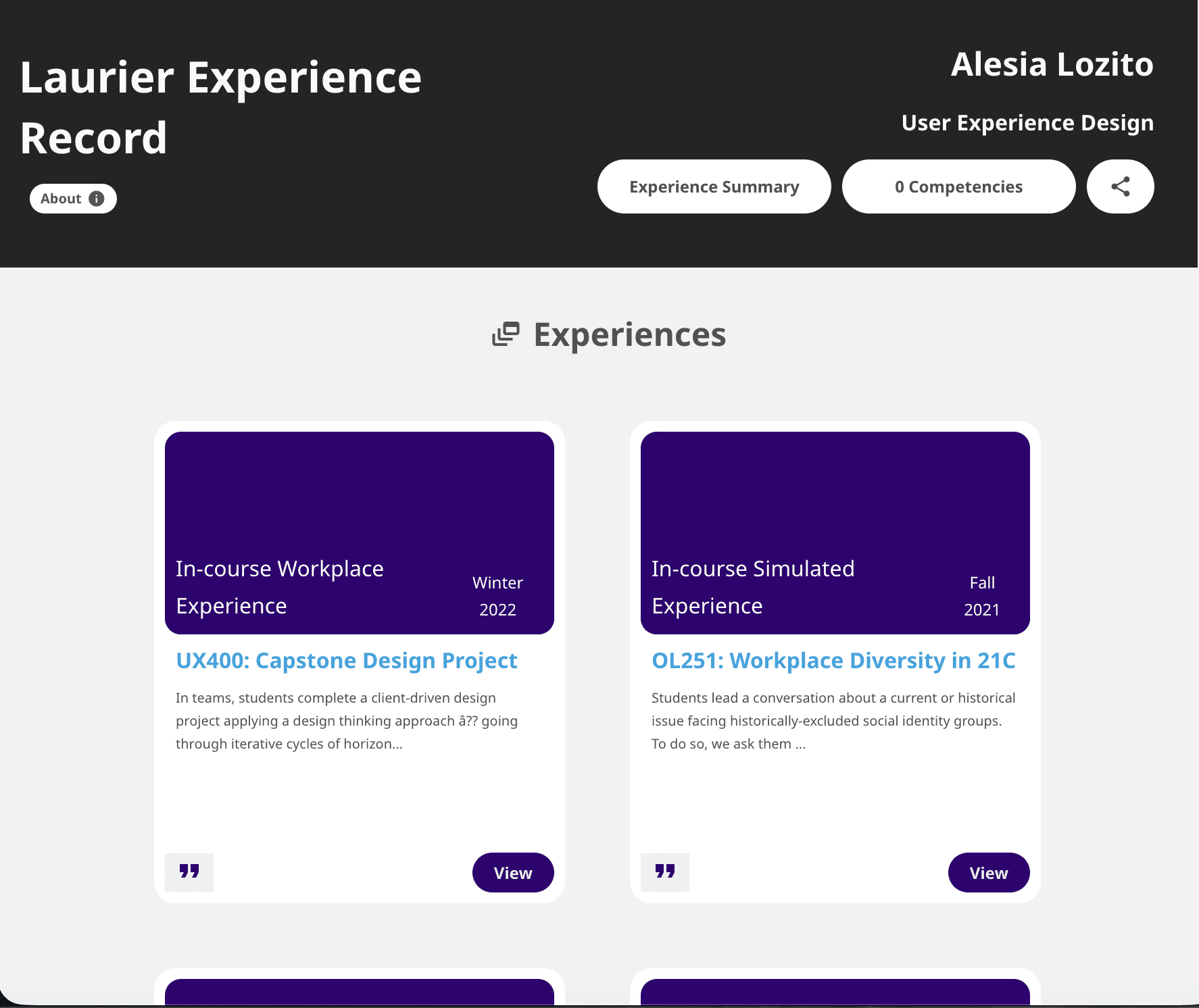
Centralized platform for capturing, reflecting on, and showcasing student experiences.
Student-controlled visibility and competency-based storytelling beyond traditional resumes.
Scannable, professional interface adopted across post-secondary institutions in North America.
[Impact]
Widespread Adoption
Implemented at multiple universities and colleges across North America.
Enhanced Student Engagement
Guided reflection and public visibility encourage students to actively document experiences
Improved Skill Communication
Students are better able to articulate transferable skills and growth to potential employers
Streamlined Usability
Dashboard improvements reduced friction in logging and managing experiences, improving efficiency
Employer Benefit
The card-based, professional presentation allows employers to quickly understand student competencies and relevant experiences.
[Reflection]
This project emphasized designing beyond individual screens and into systems and communication.
Key Takeaways
Clarity is structural, not just visual
Strong UX helps users express what they already know
Systems thinking is essential for complex, information-heavy problems
Designing this experience reinforced the importance of creating tools that don’t just store information but translate it into meaningful understanding.