[Case 02]
Competency Pathways
Transforming student experiences into measurable, career-ready competencies
Competency Pathways
Designing a guided pathway that helps students understand their current competencies, explore future development, and connect their academic journey to the experiences of those who came before them.
[Project Overview]
A digital competency pathway designed to help students visualize their development throughout their academic journey.
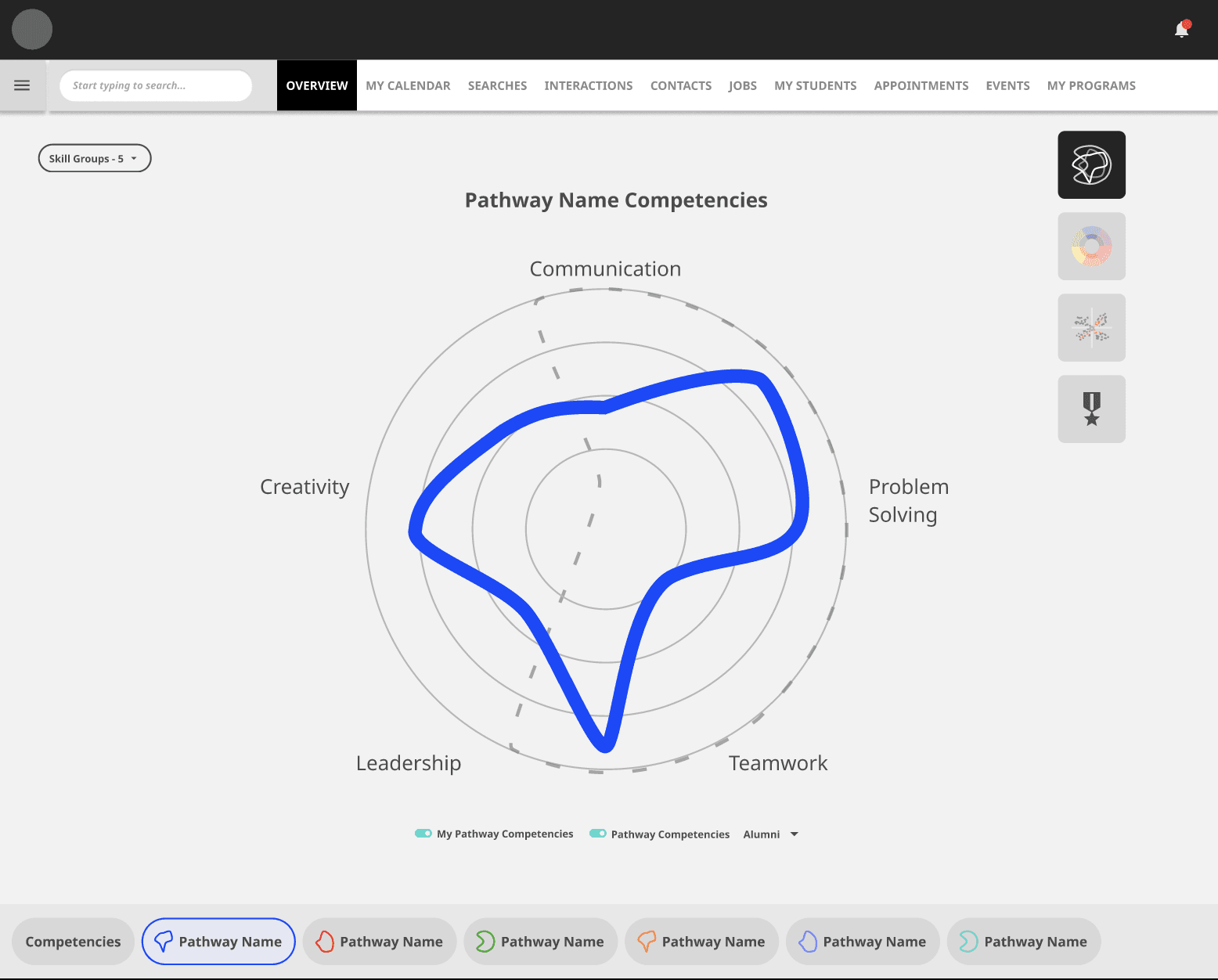
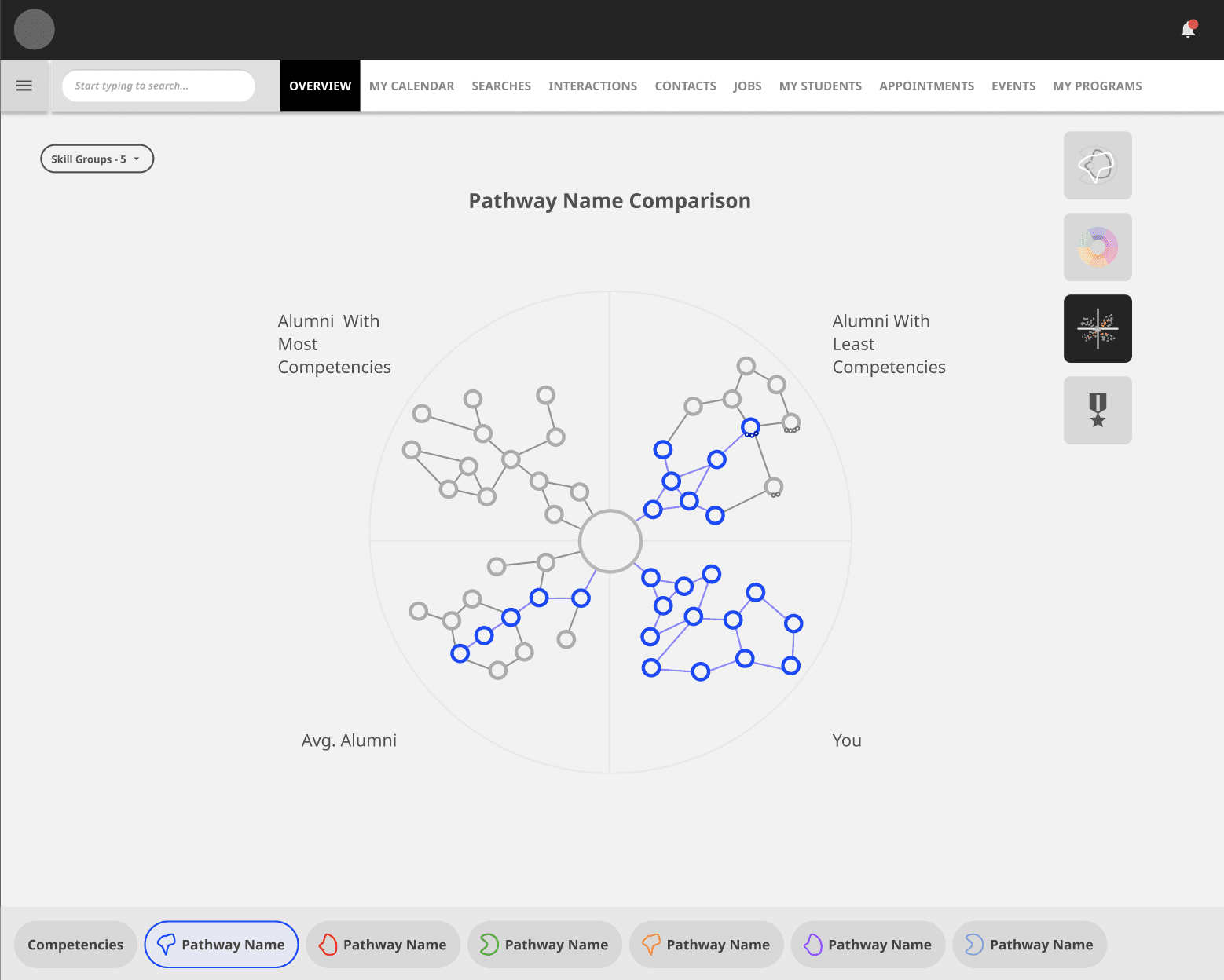
Students can explore a pathway of their choosing—such as a program or academic stream—and compare their current competencies with those demonstrated by upper-year students and alumni. The experience also highlights future competencies they could work toward as they progress.
Rather than simply showing students where they are, the pathway helps them understand where they could go next.
[Problem Statement]
Students often have a clear understanding of their academic requirements, but less visibility into the competencies and experiences they can develop throughout their education.
Traditional program pathways focus primarily on courses and academic milestones. They don't always show students how their skills develop over time, what competencies others have gained, or what they could work toward next.
This creates an opportunity to make competency development more visible and actionable.
The challenge was to design an experience that could help students:
Understand their current competencies
See how their development compares with peers further along in their academic journey
Identify competencies they could work toward
Explore potential pathways without feeling overwhelmed by complex information
[Role]
Product Designer
End-to-End UX/UI
[Focus]
Product Thinking
Systems Design
Information Architecture
Goals & Outcomes
Primary Goal
Create an intuitive pathway experience that helps students understand competency development over time and identify meaningful opportunities for future growth.
[Goals]
Create Visibility → Make competency development easier for students to understand and explore.
Show Progression → Help students visualize how competencies can develop throughout their academic journey.
Enable Comparison → Allow students to compare their current competencies with those demonstrated by upper-year students and alumni.
Encourage Future Development → Surface competencies and opportunities students could work toward next.
Design for Scalability → Create a flexible framework that could support different programs and academic pathways.
[Outcomes]
Visualize Progression → Show how competencies develop throughout a student's academic journey.
Enable Comparison → Allowed students to compare their current competencies with those of upper-year students and alumni.
Identify Next Steps → Help students recognize opportunities for continued growth and development.
Simplify Complexity → Translated complex competency relationships into an intuitive, easy-to-navigate experience.
Build for Scalability → Created a flexible framework that can adapt across different academic programs and competency pathways.
[Process]
[01] Research
Explored how students currently understand and track their competency development.
Identified opportunities to make future skills and progression more visible.
Mapped the needs of students across different stages of their academic journey.
[02] Ideation & Exploration
Explored different ways to visualize competency progression and comparison.
Tested approaches for showing current, developing, and future competencies.
Defined a pathway structure that balanced context, flexibility, and simplicity.
[03] Design Process
Designed an end-to-end pathway for exploring competencies and development.
Created interactions for comparing progress with upper-year students and alumni.
Built a flexible framework that could support different programs and pathways.
[04] Design Refinement
Refined layouts and interactions to improve clarity and navigation.
Simplified complex competency information to reduce cognitive load.
Iterated on the experience to create a more intuitive pathway for students.
[Final Solution]
An end-to-end competency pathway experience.
Allowed students to identify skills and competencies they could work toward throughout their academic journey.
Designed to be flexible enough to support different academic programs and pathway structures.


[Impact]
Because this concept has not yet been implemented, the impact of the project is best represented through the experience and framework established by the design.
Clear Competency Progression
Created a visual way for students to understand how competencies can develop throughout their academic journey.
Peer & Alumni Visibility
Introduced a comparison model that gives students examples of competency development from those further along in their academic experience.
Future-Oriented Guidance
Shifted the experience from simply documenting existing competencies toward helping students identify opportunities for continued development.
Scalable Framework
Established a flexible product structure that could be adapted to different programs and academic pathways.
[Reflection]
This project reinforced the importance of designing systems rather than individual screens.
The challenge wasn't simply determining how to display competencies—it was understanding how different pieces of information could work together to tell a meaningful story about student development.
Key Takeaways
Progress is more meaningful when it has context.
Showing students what they have achieved becomes more valuable when they can understand how it relates to where they could go next.Comparison can provide direction.
Upper-year students and alumni can act as reference points, helping students visualize possibilities without prescribing a single path.Complex systems need simple entry points.
The underlying competency framework can be complex, but the student's experience should remain intuitive and approachable.Designing for scalability requires thinking beyond the first use case.
The pathway needed to work as a framework that could extend across different programs, competencies, and student journeys.
Ultimately, this project shifted my thinking from designing experiences that simply show information to designing experiences that help users understand what that information means and what they can do with it next.
[Case 04]
Competency Pathways
Transforming student experiences into measurable, career-ready competencies
Competency Pathways
Designing a system that bridges academic learning and real-world experience.
[Project Overview]
A digital platform that enables students to document, reflect on, and validate their experiences, transforming them into structured, shareable competencies.
Traditional transcripts capture grades.
This system captures capability.
[Problem Statement]
Students graduate with a wide range of valuable experiences, internships, volunteer work, leadership roles, but struggle to clearly communicate what they’ve learned from them.
Traditional transcripts:
Emphasize grades over skills
Lack real-world context
Fail to capture competencies like leadership, collaboration and problem-solving
As a result, students are underrepresented in the job market and employers lack meaningful insight into their capabilities.
[Role]
UX/UI Designer
[Focus]
Product Thinking
Systems Design
Student Experience
Goals & Outcomes
Primary Goal
Create a structured system that translates student experiences into clear, credible and career-ready competencies.
[Goals]
Clarify Student Value → Enable students to confidently articulate what they’ve learned from their experiences.
Increase Skill Visibility → Make competencies more accessible and understandable beyond traditional transcripts.
Establish Credibility → Introduce validation to ensure experiences are trusted and meaningful.
Design a Scalable System → Build a framework that can adapt across programs and institutions.
[Outcomes]
Improved Self-Expression for Students → Students can confidently translate experiences into structured skills.
Stronger Employer Understanding → Employers gain clearer insight into candidate capabilities beyond grades.
Increased Reflection & Engagement → Students become more intentional about documenting and reflecting on experiences.
Bridged Academic and Real-World Learning → Experiential learning becomes more integrated into formal education systems
[Process]
[01] Research
Students lacked a centralized way to track and reflect on experiences.
Non-academic work was often undervalued or disconnected from career paths.
Traditional resumes failed to capture depth, reflection and transferable skills.
[02] Ideation & Exploration
Explored multiple ways to input, manage and showcase experiences.
Tested layout directions including timeline and card-based structures.
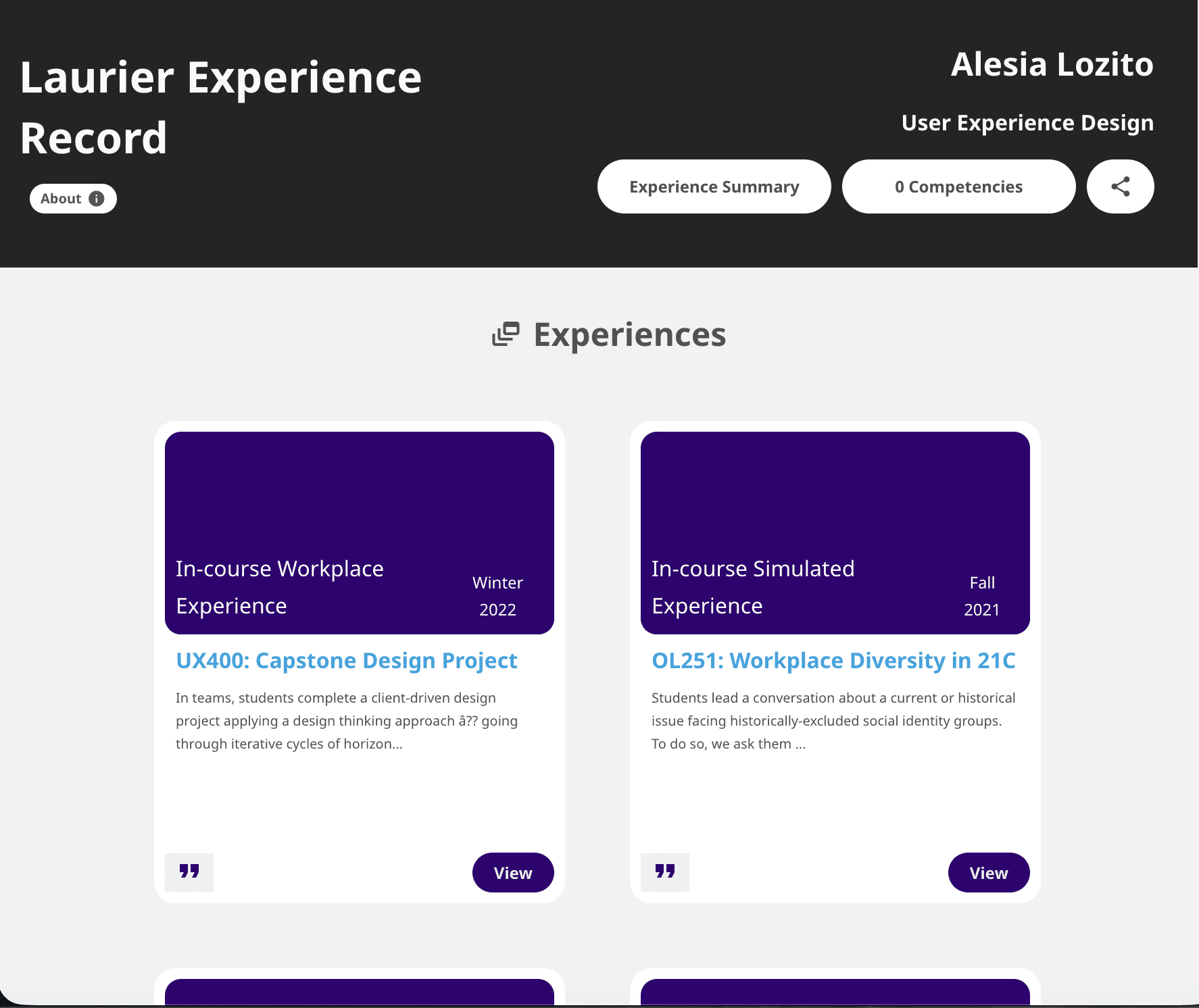
Selected a card-based approach to improve scannability for students and employers.
[03] Design Process
Designed a system balancing structure and flexibility for documenting experiences.
Built card-based views and expandable details with competencies and reflection.
Enabled guided inputs and sharing controls to support engagement and visibility.
[04] Testing & Iteration
Identified friction from unnecessary clicks and inefficient flows.
Streamlined interactions and optimized dashboard density for better usability.
Iterated on layout to improve clarity, flexibility, and overall experience.
[Final Solution]
Centralized platform for capturing, reflecting on, and showcasing student experiences.
Student-controlled visibility and competency-based storytelling beyond traditional resumes.
Scannable, professional interface adopted across post-secondary institutions in North America.
[Impact]
Widespread Adoption
Implemented at multiple universities and colleges across North America.
Enhanced Student Engagement
Guided reflection and public visibility encourage students to actively document experiences
Improved Skill Communication
Students are better able to articulate transferable skills and growth to potential employers
Streamlined Usability
Dashboard improvements reduced friction in logging and managing experiences, improving efficiency
Employer Benefit
The card-based, professional presentation allows employers to quickly understand student competencies and relevant experiences.
[Reflection]
This project emphasized designing beyond individual screens and into systems and communication.
Key Takeaways
Clarity is structural, not just visual
Strong UX helps users express what they already know
Systems thinking is essential for complex, information-heavy problems
Designing this experience reinforced the importance of creating tools that don’t just store information but translate it into meaningful understanding.
[Case 04]
Competency Pathways
Transforming student experiences into measurable, career-ready competencies
Goals & Outcomes
Primary Goal
Create a structured system that translates student experiences into clear, credible and career-ready competencies.
[Goals]
Clarify Student Value → Enable students to confidently articulate what they’ve learned from their experiences.
Increase Skill Visibility → Make competencies more accessible and understandable beyond traditional transcripts.
Establish Credibility → Introduce validation to ensure experiences are trusted and meaningful.
Design a Scalable System → Build a framework that can adapt across programs and institutions.
[Outcomes]
Improved Self-Expression for Students → Students can confidently translate experiences into structured skills.
Stronger Employer Understanding → Employers gain clearer insight into candidate capabilities beyond grades.
Increased Reflection & Engagement → Students become more intentional about documenting and reflecting on experiences.
Bridged Academic and Real-World Learning → Experiential learning becomes more integrated into formal education systems
[Process]
[01] Research
Students lacked a centralized way to track and reflect on experiences.
Non-academic work was often undervalued or disconnected from career paths.
Traditional resumes failed to capture depth, reflection and transferable skills.
[02] Ideation & Exploration
Explored multiple ways to input, manage and showcase experiences.
Tested layout directions including timeline and card-based structures.
Selected a card-based approach to improve scannability for students and employers.
[03] Design Process
Designed a system balancing structure and flexibility for documenting experiences.
Built card-based views and expandable details with competencies and reflection.
Enabled guided inputs and sharing controls to support engagement and visibility.
[04] Testing & Iteration
Identified friction from unnecessary clicks and inefficient flows.
Streamlined interactions and optimized dashboard density for better usability.
Iterated on layout to improve clarity, flexibility, and overall experience.
[Final Solution]
Centralized platform for capturing, reflecting on, and showcasing student experiences.
Student-controlled visibility and competency-based storytelling beyond traditional resumes.
Scannable, professional interface adopted across post-secondary institutions in North America.
[Impact]
Widespread Adoption
Implemented at multiple universities and colleges across North America.
Enhanced Student Engagement
Guided reflection and public visibility encourage students to actively document experiences
Improved Skill Communication
Students are better able to articulate transferable skills and growth to potential employers
Streamlined Usability
Dashboard improvements reduced friction in logging and managing experiences, improving efficiency
Employer Benefit
The card-based, professional presentation allows employers to quickly understand student competencies and relevant experiences.
[Reflection]
This project emphasized designing beyond individual screens and into systems and communication.
Key Takeaways
Clarity is structural, not just visual
Strong UX helps users express what they already know
Systems thinking is essential for complex, information-heavy problems
Designing this experience reinforced the importance of creating tools that don’t just store information but translate it into meaningful understanding.
Competency Pathways
Designing a system that bridges academic learning and real-world experience.
[Project Overview]
A digital platform that enables students to document, reflect on, and validate their experiences, transforming them into structured, shareable competencies.
Traditional transcripts capture grades.
This system captures capability.
[Problem Statement]
Students graduate with a wide range of valuable experiences, internships, volunteer work, leadership roles, but struggle to clearly communicate what they’ve learned from them.
Traditional transcripts:
Emphasize grades over skills
Lack real-world context
Fail to capture competencies like leadership, collaboration and problem-solving
As a result, students are underrepresented in the job market and employers lack meaningful insight into their capabilities.
[Role]
UX/UI Designer
[Focus]
Product Thinking
Systems Design
Information Architecture